A Gorgon’s Tale: Mythographia
The story of Medusa is well known.
A beautiful maiden and priestess of Athena, Medusa is assaulted by Poseidon in the goddess’s temple. In her rage, Athena punishes Medusa for the desecration by turning her into a hideous gorgon with snakes for hair, and a gaze that turns whoever should look upon her to stone. She is a monster to be feared until Perseus, with Athena’s help, slays her and gives the goddess her head.
So wrote Ovid in Metamorphoses about Medusa and not Athena, but rather her Roman counterpart Minerva. (That’s a whole other blog).
Never really human?
The earliest mythology of Medusa paints a rather different picture. Tracing the origins of Medusa farther back suggests something at once more primordial and more powerful.
I’ve been on her trail as I research for my work-in-progress, Seeking Athena.
Partly it’s out of a desire to redeem the Greek Goddess of Wisdom from her Roman counterpart’s purity-politics. Partly it’s a fascination with the symbolism and power of a chthonic Medusa in her purest form - as a Gorgon who was never human.
The first time in literature that we come across Medusa (as far as I can tell) is Homer, where Athena is described as carrying her visage on her shield.
In Hesiod’s Theogony, Medusa is one of three Gorgons born to Ceto and Phorcys, who also gave birth to the Graiae (a triad of women who were born old). Hesiod says they dwelt “beyond glorious Ocean in the frontier land towards Night”. Importantly here Medusa is born a Gorgon, but unlike her sisters she is mortal. There is no description of how she looks but Hesiod says she lay with the ‘Dark-haired One’ (Poseidon) in a soft meadow amid spring flowers, and that when “Perseus cut off her head, there sprang forth” the horse Pegasus and mighty Chyrsaor.
Triads
Like their sisters the Graiae, like the Moirai (Fates), the Gorgons represent a trinity of the divine feminine. And the association with the snake goddess — something Athena also shares through her own proto-origins in Minoan Crete — is very ancient, suggesting an origin for Medusa that is at once more powerful, fertile and divine, and less patriarchal than later Roman myth.
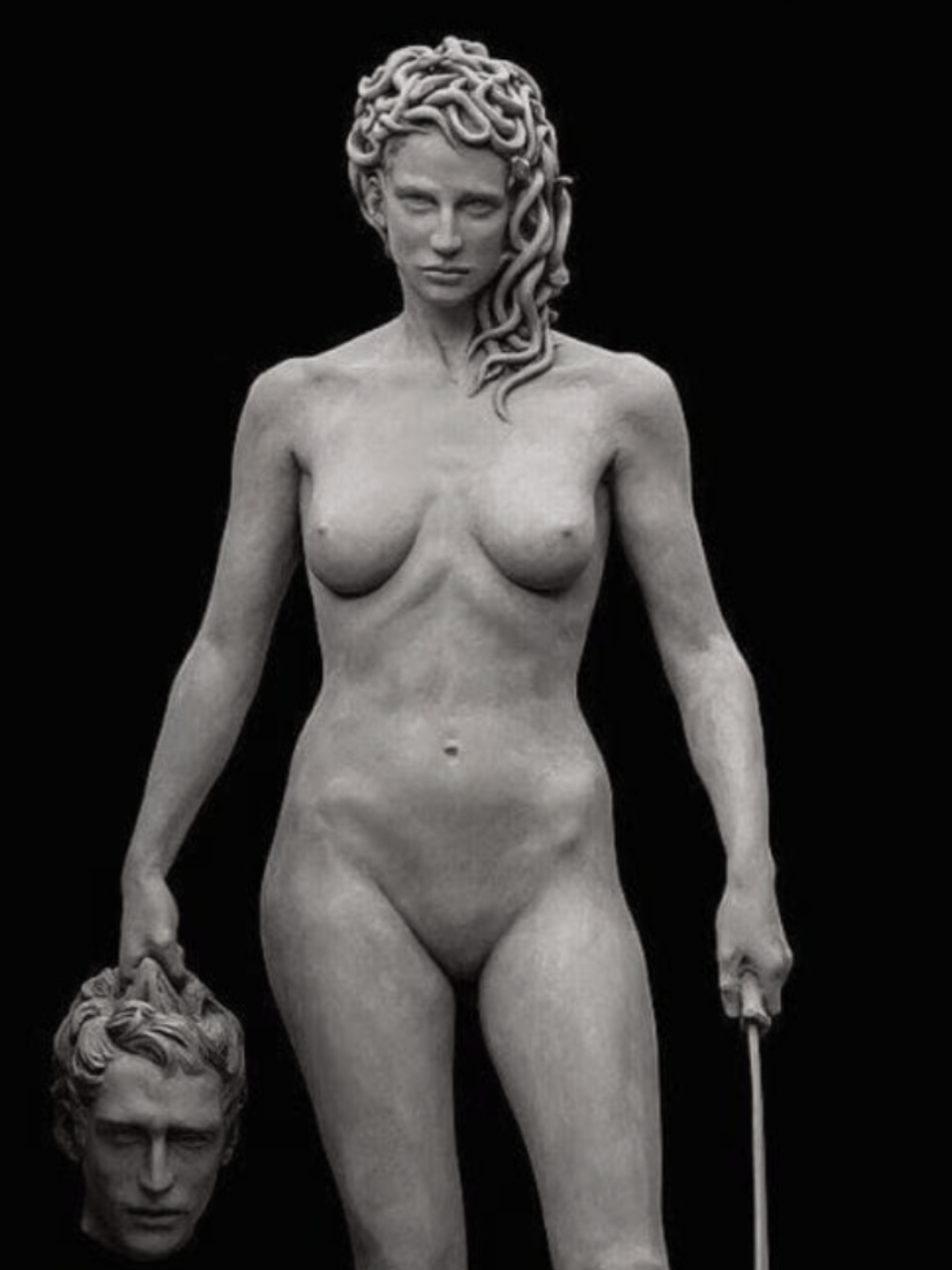
Luciano Garbati’s sculpture “Medusa With the Head of Perseus”
The Gorgoneion
This is born out to some degree by the way Medusa’s head - the Gorgoneion - was frequently used as a protective amulet in ancient Greek art. Often depicted on shields, armour, coins and buildings, it was a terrifying protection against the evil eye. This belief in her ability to repel negative forces positions her as a chthonic guardian, a gatekeeper rather than a monster. Early depictions of Athena bearing the Gorgoneion on her shield, can be understood then as a link both to her own proto-past and to the might and power of the Gorgon.
Perhaps that’s why we’re still so compelled by her. Perhaps that’s why her strength was recast as a curse rather than a gift.
Reclaiming the mythology
My quest to reclaim the story of Medusa from our Roman friends and return her to her Greek origins is probably in vain. But as we walk through the icy halls of the Gorgon — using our mirrors to guide the way — we might yet catch a glimpse of her as she really is. Fearsome, certainly. But offering us a vision of our own fertile power and the untameable wildness we come from.